
AI Engineer Interview Questions, Practiced Out Loud
This plan is spoken practice for AI engineer interview questions on LLM basics, RAG system design, agentic AI and tool use, your own AI project, and live coding. Tim plays a senior AI engineer who keeps asking follow-ups until your answer is solid. You practice explaining ideas clearly and defending your design choices, not just reciting definitions.
- Free
- 3 h 50 min in total
- 5 skills
- 5 guided lessons
- 10 spoken practices
Free to start. You practice by voice, so find a quiet spot and use your microphone.
Tell your coach your role and date, and it rebuilds this plan for you.
Make it yours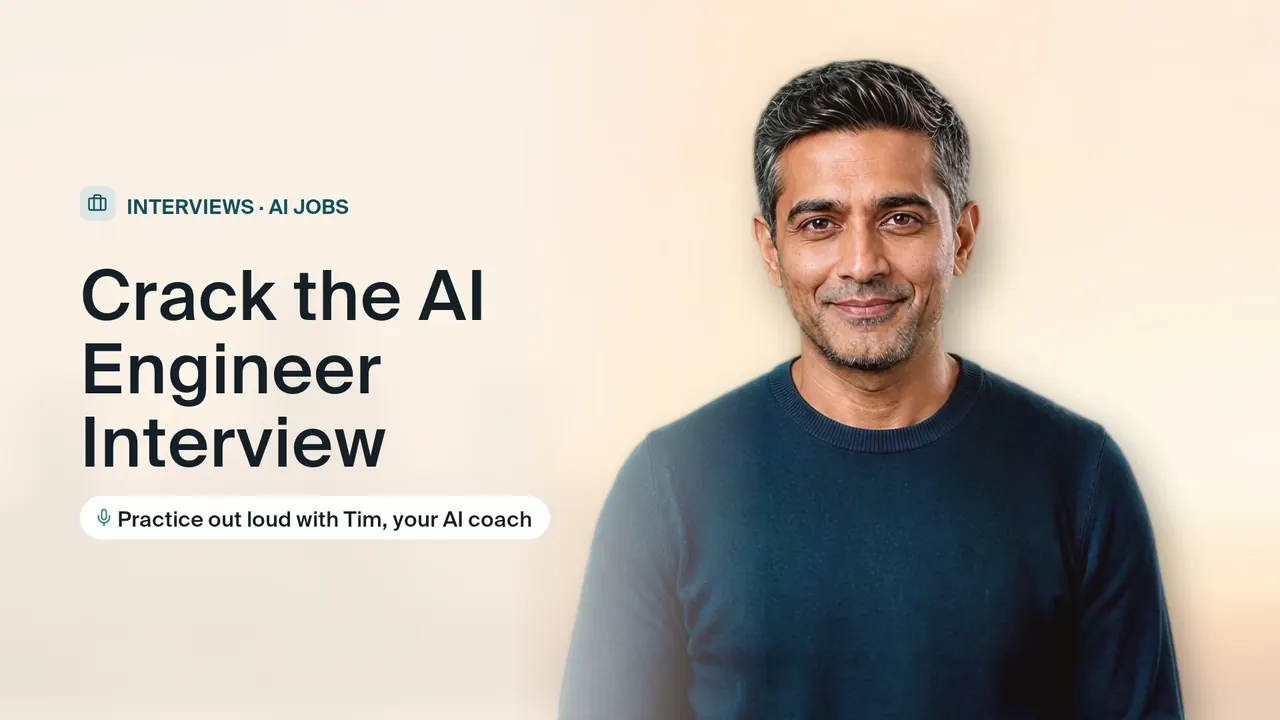
Answer agentic AI, RAG and GenAI interview questions with clarity and depth.
Who this goal is for
- You are a software engineer moving into AI or GenAI roles and need to explain LLM concepts confidently.
- You have built a RAG or agent project and want to defend your design decisions under questioning.
- You are an ML engineer whose interviews now include agentic AI and system design rounds.
- You understand the concepts when you read them but struggle to explain them clearly out loud.
About this goal
For engineers interviewing for AI, ML and GenAI roles. Practice explaining LLM basics, designing a RAG system, agentic AI and tool use, presenting your AI project, and thinking out loud on coding and system questions. Tim plays a senior AI engineer who asks follow-ups until your answer is solid.
What you will learn and practice
5 skills, each taught in a guided lesson and then practiced out loud with the coach.
3 h 50 min total5 lessons10 practices
Explaining LLM basics clearly
Skill 1, 45 min, 3 sessionsYou will meet with a coach to practice translating complex technical terms into simple analogies. You will practice explaining how smart text systems process words, recall information, and control their creativity.
- Lesson
Simplify how language models work
15 min - Practice
Explain core text generation concepts
15 minTim asks you to explain tokens, context windows and temperature as if to a teammate. He checks that you use plain language and a good analogy before adding technical detail.
- Practice
Compare model customization methods
15 minYou compare prompting, retrieval and fine-tuning for a given use case. Tim listens for when you would choose each one and whether you mention cost, data needs and maintenance.
- Lesson
RAG system design
Skill 2, 45 min, 3 sessionsYou will meet with a coach to break down how to explain search-based AI systems in an interview. You will practice structuring your thoughts around data preparation, search logic, and quality checks.
- Lesson
Map out your system design strategy
15 min - Practice
Explain the data pipeline out loud
15 minYou walk Tim through a RAG pipeline from document ingestion and chunking to retrieval and the final prompt. He probes each stage and checks that your choices are justified.
- Practice
Tackle incorrect answers and evaluation
15 minTim describes a RAG system giving wrong or made-up answers and asks how you would find the cause. He checks that you separate retrieval problems from generation problems and describe how you would measure quality.
- Lesson
Agentic AI and tool use
Skill 3, 45 min, 3 sessionsYou will work with a coach to structure your explanations of how independent AI systems make decisions and use tools. You will outline real-world examples of system failures and safety controls for a project you choose.
- Lesson
Prepare your agent interview responses
15 min - Practice
Practice explaining smart AI behaviors
15 minYou explain how an agent plans, chooses tools and uses results to decide its next step. Tim listens for a clear loop description and a concrete example from a real use case.
- Practice
Defend your system safety choices
15 minTim challenges the safeguards on an agent you designed, from tool permissions to human approval steps. He checks that you name realistic failure cases and explain how your controls catch them.
- Lesson
Your AI project story
Skill 4, 45 min, 3 sessionsYou will work with a guide to outline a past project you built. You will learn to highlight your technical decisions and outline what you would improve in under two minutes.
- Lesson
Structure your quick project presentation
15 min - Practice
Pitch your project and explain choices
15 minYou present an AI project you built in under two minutes, then explain the key technical decisions. Tim checks that the problem, your role and the result come through clearly.
- Practice
Answer tough questions about your limits
15 minTim asks what your project does badly, what broke and what you would rebuild. He listens for honest limits, evidence you measured them and a sensible improvement plan.
- Lesson
Live coding and system questions
Skill 5, 50 min, 3 sessionsYou will meet with your guide to explore strategies for talking through your programming choices. You will practice asking clarifying questions and learning how to handle moments when you do not know the answer.
- Lesson
Learn to explain your code aloud
20 min - Practice
Clarify requirements and think aloud
15 minTim gives you an open coding or design problem and you ask questions before starting. He checks that you confirm inputs and constraints, then narrate your approach as you work.
- Practice
Solve problems when you get stuck
15 minTim hands you a problem where you are likely to hit a wall. He checks that you say what you are trying, test a simpler case and keep reasoning out loud instead of going quiet.
- Lesson
How practice works with the AI coach
Creatium Coach is a live AI voice coach. You do not watch videos or fill in quizzes: you talk, it listens, and it answers like the real person would.
Learn it with a guide
Each skill opens with a guided lesson. The coach explains the idea, asks you questions and checks you have it before you move on.
Practice it out loud
In each practice the coach plays the other side: the interviewer, the customer, the buyer or your team. You answer in your own words, by voice.
Get one thing to fix
After every answer you hear what worked and the one change that would make it stronger, then you try again until it sounds right.
Make it yours
Tell the coach your role, your company or your situation and it reshapes the plan around your goal. The ready-made goal is just the start.
Questions about ai engineer interview questions
How do I prepare for an AI engineer interview?
Cover four areas: LLM fundamentals such as tokens, context windows, embeddings and sampling settings; system design for RAG and agent-based applications; evaluation and failure handling; and at least one project you can explain in depth. Practice explaining each topic simply first, then add detail when asked, since interviewers often probe with follow-ups. Be ready to discuss trade-offs like cost, latency and accuracy. This plan lets you rehearse each area out loud with Tim playing a senior engineer who asks those follow-ups.
What is the difference between agentic AI and generative AI?
Generative AI refers to models that create content such as text, images or code in response to a prompt. Agentic AI uses such models as part of a system that can plan steps, call tools or APIs, observe results and decide what to do next toward a goal, often over several turns. In short, a generative model produces an output, while an agent takes actions and loops until a task is done. The agentic AI session in this plan has you explain this distinction and defend the safety controls you would put around an agent.
What RAG interview questions are asked for experienced roles?
Experienced candidates are often asked how they would chunk and index documents, choose embedding models, combine keyword and vector search, rerank results, and handle questions the knowledge base cannot answer. Expect questions about evaluating retrieval and answer quality, reducing hallucinations, keeping indexes fresh, and controlling cost and latency. Interviewers usually want trade-offs from real projects rather than textbook definitions. The RAG system design session in this plan has you walk Tim through a pipeline and handle his questions on wrong answers and evaluation.
More in Interviews & Careers

Ace Your Job Interview
Practice the questions before they ask, out loud, with feedback on every answer.
Crack Campus Placements
HR, group discussion and the technical round, practiced before placement day.
Pass Your BPO Interview
The initial interview, the English check and the call simulation, practiced first.
Start Crack the AI Engineer Interview for free
Your coach builds the plan, teaches each skill and practices with you out loud until you are ready.